Senior Book Chat

Tille Olsen’s Tell Me a Riddle, Requa I, and other stories

Our September 9, 2024 Book Group discussed Tillie Olsen’s Tell Me A Riddle, a collection of four short stories first published in a slim book in 1927. All four stories were featured in Best American Short Stories, in the year each was first published in a literary magazine. The title story was awarded the O. Henry Award in 1961 for best American short story. The group had read Tillie Olsen’s short story “I Stand Here Ironing,” before, and were excited that a member suggested this collection as a chance to read more of her work.

Let me digress a bit here to describe how the book list selection process has evolved. I chose the selections initially, drawing on stories assembled in my Book of Old Ladies that had been favorites in my courses at Mills College. We maintained the theme, focusing on “women of a certain age” as the main characters. 

Eventually the entire group participated  in proposing books, pitching them and then taking a vote. We considered broadening the theme, and read several books by men, opening the genre to include essay collections by Ursula LeGuin and Ann Patchett, and then returned to our initial theme of old women but maintained the inclusion of essays and memoirs. 

We now limit recommendations to two per member and then vote, trying to select one from each pairing. Sometimes several members agree on a single book, and reduce the list prior to a final vote. Then I create the order of books, taking into consideration length and topic. We read or listen to the longest books over the lengthy break between series. 

We have also changed our discussion format. Initially I assembled a list of open-ended questions and led discussion. Later, various members took turns creating the questions and leading the discussions. Now we each show up with an observation or a question, usually sharing a few sentences from the text that either delighted or confused us.

Back to Tell Me a Riddle. In advance of the discussion, I wrote a bit about my responses to the stories, and my connections to and responses to Tillie Olsen. Tille Olsen’s writing introduced me to many writers of what we began to call Working Class Literature;  the Feminist Press began to publish some of the then out of print works she brought to light. When I was a student in UC Berkeley’s graduate program.  I invited her to a graduate course on California Women Writers, where her work was not included.  Later, I  invited her to read aloud “I Stand Here Ironing” at Mills. Olsen reminded me a little of my mother, also an Olsen, also a working class woman, a maid, raised to be a wife and mother, writing poetry on the backs of envelopes and grocery receipts. In Silences, Olsen accounts for the years between her literary outputs: “She did not write for a very simple reason: A day has 24 hours. For 20 years she had no time, no energy and none of the money that would have bought both.” Both Tillie Olsen’s life and my mother’s contrasted starkly with university culture, and after meeting Tillie Olsen I wanted my Mills students, especially those first generation students like me, to be encouraged to write their untold stories. 

In our group, everyone had much to offer about their own connections to Olsen’s work. A librarian in the group considered the implications of  the subject headings under which the collection is listed  in library’s catalogs. Another member who was familiar with the names Jack and Tillie Olsen from her family’s connections with the Longshoremen Union  told us about the housing cooperative Tillie Olsen and her husband helped establish in the Western Addition. Our discussion included close analysis of the prose and general discussions of class and race, of mothers and daughters, of the “sorting” that occurs among children as they move into middle school. We all learned something beyond our own initial reading, and it was one of the richest discussions we have had.

Several people read the most recently published version from the University of Nebraska  Press that includes not only the 4 stories but also a longer piece of writing, Requa, perhaps her most experimental work, some of her political articles, and several wonderful critical essays by family members, daughters Laurie Olsen and Julie Olsen Edwards and a stellar introduction by her granddaughter, Dr. Rebekah Edwards, a long time visiting professor at Mills as well as an alum and a dear friend of my daughter, Kirsten. I highly recommend reading Tillie Olsen’s work, and if you can, reading this edition.

Senior Book Chat

While it is less than half the length of The Stone Diaries, it is a lyric and non linear novel, an early example of a stream of consciousness narrative. After completing  Carol Shield’s fictional account of the multiple decades of Daisy Goodwill’s life, we read Virginia Woolf’s fictional account of the Ramsays based closely on her parents, particularly Julia Stephens, in which the life is squeezed into an account of a single day, a death recorded in parentheses, and a rendering of the ways in which Mrs. Ramsay’s legacy lingers in Lily’s mind. Both novels confront the reader with those not so simple questions:  What is the meaning of a life? And what does it mean to “know” another person?

To the Lighthouse is a book in three parts, in three movements. All of it is laid at the Summer home of an English family named Ramsay in the Hebrides, the first portion occupying an afternoon and evening, the second portion constituting an interlude of ten years during which the house remains unoccupied, the third portion occupying a morning at the end of these ten years. The Ramsays are a middle-aged couple, when the book opens, with eight children, who have with them at their Summer place about half a dozen friends including the young unmarried artist Lily Briscoe. Woolf uses the figures of Mr. and Mrs. Ramsay as the archetypal marriage, and the eccentric unmarried artist, Lily Briscoe, to engage ideas about gender relations, marriage, war, home, meaning, truth. Woolf uses stream of consciousness—a style of writing meant to mimic the way thoughts flow through people’s minds.

Most of the books we choose are plot driven, moving through time in a linear fashion, chapter by chapter, often with one point of view, or sometimes a sequence of chapters is narrated by separate characters. In contrast, Woolf’s stream of consciousness moves inside and outside characters’ heads, forward and backward in time, and the vivid prose and imagery is similar to that of poetry. 

I began receiving emails from members who were struggling to finish the novel. I shared notes from my teaching days, introducing stream of consciousness and some critical reflections on  the novel, hoping to convince everyone to love one of my favorite books. While I did not convert everyone to Woolf, the discussion was animated, and we all appreciated hearing each person’s remarks. 

Coming away from the novel, we were left with its essential question:  What is the meaning of life? Mrs. Ramsay repeatedly asks the question in Part I, and in Part III, trying to finish her painting of Mrs. Ramsay, Lily echoes it:  

What is the meaning of life? ‘That was all–a  simple question; one that tended to close in on one with years. The great revelation had never come. Instead there were little daily miracles, illuminations, matches struck unexpectedly in the dark;…Mrs. Ramsay saying, “Life stand still here”….In the midst of chaos there was hope; this eternal passing and flowing.

As Lily ponders the impossibility of ever really knowing another person, she thinks of the habit we all have of making up scenes about others based on bits and pieces  “what we call knowing people,” and realizes there are no guides to answer the question about life’s meaning, but rather that “so much depends upon distance: whether people are near us or far from us….” 

As Lily continues and eventually completes her painting, her vision of Mrs. Ramsay, she thinks:  “One wanted fifty pairs of eyes to see with…Fifty pairs of eyes were not enough to get round that one woman with” and as Lily finishes her canvas with a single brush stroke, Woolf ends the novel with Lily’s words “I have had my vision.”

Senior Book Chat

The Stone Diaries by Carol Shields

Just before the pandemic, I first discussed a selection from my Book of Old Ladies with seniors at the Downtown Oakland Senior Center, meeting in person in a large ballroom where over 70 seniors met with my small Mills seminar of 15 students to discuss Toni Cade Bambara’s short story, “My Man Bovanne .” We intended to meet monthly at the center, but after our second meeting to discuss “They May Not Mean To, But They Do,” the pandemic precluded meeting in person and we turned to Zoom, then a startling new technology for most of us.  

Going forward, I intend to use this blog  to update you on our current readings in the hopes that you may find the books and discussions of interest!

Since we have already met twice (life does show up in the way of good intentions as we all know!), we have had two sessions already this season, and so I will start with a brief account of of these and give you a heads up on what follows in case you want to read along with us.

On August 11, we discussed Carol Shield’s 1993 novel, The Stone Diaries. We selected this novel because of its importance to the member who originally recommended it and said she found it a good companion during the long days she sat by her dying father’s hospital bed

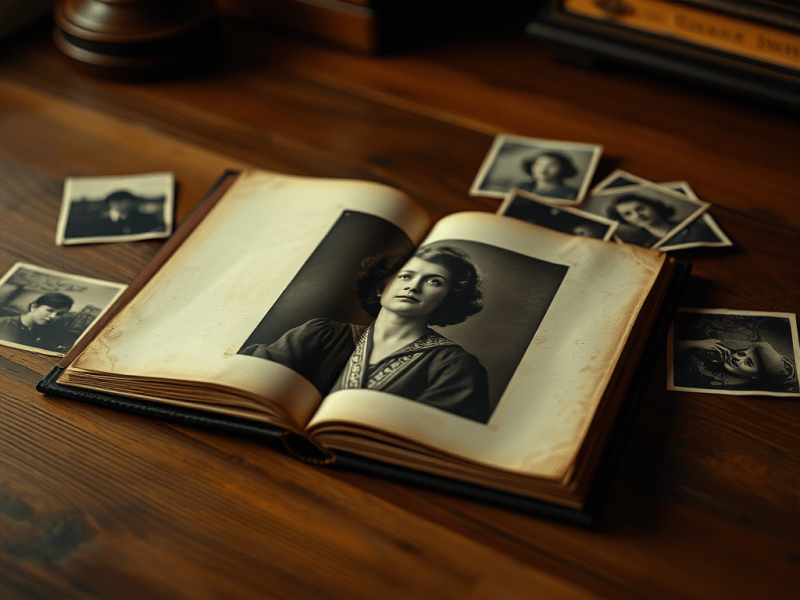
The novel is a fictional autobiography which follows the life of Daisy Goodwill from her unusual birth to her quiet death, drawing on diaries, letters, newspaper articles, and other  “real life” materials to document the life of an ordinary woman. While I need to listen to books because of my vision, I purchased a second hand copy of the novel so I could see the photographs included in this facsimile of a biography, and I was interested to learn Shields used photographs of her own children to represent Daisy’s three children and drew on vintage  photographs purchased in thrift shops to represent the other characters. 

Shields commented that with this novel, she finally wrote the book she wanted to read: one in which an ordinary woman, with no astonishing or heroic accomplishments, lives day to day, primarily in family and domestic settings. Daisy Goodwill Flett’s life  is marked by death and loss from the beginning, when her mother dies during childbirth. Through marriage and motherhood, Daisy “struggles to understand the paradoxes of her life” (The New York Public Library), and the book is divided into ten chapters detailing each epoch of Daisy’s life.The Stone Diaries won the 1993 Governor General’s Award for English language fiction in Canada and the 1995 Pulitzer Prize for Fiction in the United States.. It also received the National Book Critics Circle Award. 

Our discussion of Stone Diaries was unusual in that readers had no questions about difficult passages. And few had marked favorite lines to share with the group, although we agreed that the writing was excellent. Perhaps because Daisy’s life felt familiar with its domestic every day focus, despite some of the tragic details of her experience. The narrator’s descriptions of Daisy are  always from the outside, never probing her interior. The arc of the novel did not lead to dramatic lows and highs; rather it, like life, echoed the rhythms of ordinary life–its intended purpose. By the end of our discussion, nearly everyone mentioned intending to read the novel again with an altered sense of expectations,, and commented on how the novel mirrors most lives, one incident follows another without building up to a crisis or tying up loose ends with a bow.

Tune in next week for Virginia Woolf’s To the Lighthouse.

A few thoughts

 Like many authors who published books in 2020 and as a professor for over 42 years, I’m particularly looking forward to sharing my work and connecting with readers in person next Saturday (you can RSVP here). The video above is from one of the first in-person readings I gave in November 2023 since The Book of Old Ladies was published.

Interview in the Mills Quarterly

I am really pleased with this wonderful article about “The Book of Old Ladies” & my spring class Coming to Age with Mills students and elders from the Downtown Oakland Senior Center. I love its inclusion of so many Mills voices!

A Future for Old Women

Professor Emerita Ruth Saxton offers alternate visions for “coming to age” in The Book of Old Ladies
By Dawn Cunningham ‘85

In her new book, Professor Emerita Ruth Saxton delves into the complex fictional worlds (and goes beyond the stereotypes) of elderly women.

Interview with Christine Hyung-Oak Lee in “The Rumpus”

“The more I read, the more I appreciate stories in which old ladies not only survive the huge losses of their lives, such as divorce, death of a spouse, serious illness, forced retirement, or alienation from adult children, but discover undeveloped parts of themselves, sometimes defy limiting conventions and habits that no longer serve them well. Stories of satisfying lives after loss lift my spirits and affirm what I have observed not only personally but also in life writing—in journals, diaries, biographies, and memoirs”

Interview with Christine Hyung-Oak Lee in “The Rumpus”