by Julia Alvarez (2024)

“Everybody is a walking library” Julia Alvarez
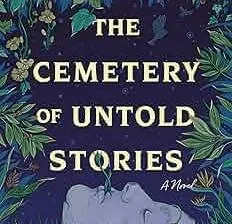
In Julia Alvarez’s most recent novel, The Cemetery of Untold Stories, her narrator, Alma Cruz, laments the many stories she has not been able to finish. Her mentor, a close friend and famous novelist, begs her to finish the incomplete story that has for years driven her to a form of madness; in attempts to better know her unwritten characters, she has traveled internationally, behaved erratically, and still been unable to move forward.
Over the course of the novel, Alma eventually comes to terms with her unfinished manuscripts, facing her mortality navigating the changes and losses of aging, and the shifts in the acts of imagination and ambition that have propelled her for over thirty years of publication, fame, and university teaching.
She decides simply to stop the arc of her present trajectory, not her life, but the life she has been leading and in which she has been struggling. She retires from her teaching position, rents out her home in Vermont, hires a former student to help box up all her manuscripts, and moves to the island she has always considered home: the Dominican Republic, the home from which her family moved when she and her three sisters were children.
Alma and her sister have inherited a dozen small parcels on the island which need to be divided amongst the four sisters. Alma, confusingly to all–readers and characters alike–chooses the parcel in what is considered the most unsavory neighborhood, adjacent to the city dump.
Once Alma relocates to the island, the narrative, like the character herself, becomes clearer. We agreed the story becomes increasingly compelling when she has relocated and, in a fantastical turn, decides to create a cemetery on her land, a cemetery for her many boxes of untold stories.
Like her readers, Alma’s neighbors in the barrio are bewildered by the concept of a cemetery for untold stories, rather than people or animals.
Eventually, Alma decides to move from her family’s vacation home and to have a small casita constructed in the cemetery.
We enjoyed reading about Alma’s friendship with the artist Brava, who eventually creates a fitting marker and sculpture for each unwritten character, each burial plot, each plotted tale untold.
Once the stories are buried, the novel shifts into glowing magical realism. The buried manuscripts transmit their stories, converse with each other and can be
heard by local woman Filomena who lives just outside the cemetery and is eventually hired by Alma to help keep an eye on the place, clean the bird shit off the sculptures and communicate with the curious neighbors. She is able to overhear the conversations between the unwritten characters, and we eavesdrop with her.
I had to listen to the audible version a second time before I could separate the multiple stories, begin to figure out the web of characters, and their many secrets and subtle connections. Central to the novel is its parallel sets of sisters: the four sisters of Alma’s lived experience, Filomena and her estranged sister, and sisters in the untold stories.Alma’s family’s lineage, and that of the “real” characters in the novel as well as the fictional characters, some of which are historically based, include details of patriarchal violence, sexism, crimes of passion, murder, repressed sexuality, adultery, and so forth.
When I asked our group to sum up the novel’s topic in a few words and offered “storytelling” as my own word, the responses included: “unfinished business; immigrant experience in New York; who owns a story?”
We welcomed the many phrases in Spanish and the sense of an expanded reading audience beyond a monolingual audience. We wondered aloud if Alvarez, like Alma had fictionalized her family members, told their secrets and angered them in the telling.Several group members intend to read her earlier fiction or to do a bit of research on her life.
We agreed we are glad we chose to read this novel, and we then segued to conversations about our own collections–things kept or unfinished: things, our books, the downsizing of our parents’ belongings as well as our own.
Perhaps because we have chosen to focus on stories of older women for over more than five years now, we are noticing patterns that reappear among stories we initially considered had nothing in common. Across a variety of tones, and formal styles, so many of our books navigate how we, as we age, navigate losses, in the present and in the recent and long past, grief, friendship, family relationships, secrets, and how we stay connected to the power of the imagination, redemption, and connection. Reading these books together connects not only the books, and their characters, but like Alma’s stories, our own.



 Ruth O. Saxton