Senior Book Chat January 2025

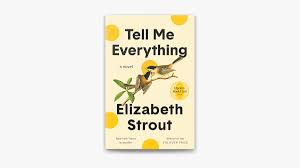
Tell Me Everything (2024) by Elizabeth Strout

“A generous, compassionate novel about the human need for connection, understanding and love, and the damage that occurs when those things are denied.”—San Francisco Chronicle

Elizabeth Strout returns to the town of Crosby, Maine, and to her beloved cast of characters — Lucy Barton, Olive Kitteridge, Bob Burgess, and others. In this novel, the community must navigate a shocking crime in their midst.

Our book group previously had read Strout’s Olive Kitteridge at my suggestion. I had taught the book at Mills, and the students found the stories engaging and thought provoking. The book group agreed, and we eagerly returned to Strout’s characters in Olive, Again, Oh, William, and Lucy by the Sea, so when we saw the announcement of Tell Me Everything, we immediately added it to our fall 2024 reading list. We anticipated Strout’s familiar conversational style, her quirky characters, with a central plot threading together all the bits and pieces. dWe were surprised by the larger cast of characters, the multiple plot lines, and we were a little disappointed.

We had not been put off by large casts of characters or multiple plot lines in other books, and we wondered why this book, well reviewed as the Chronicle quote above indicates, did not sit well with us.

Perhaps we expected her more familiar form. Unlike novelists whose books do not return to the same places or characters, Strout’s connected novels, while not formally a series, create a fictional world that invites readers to return to a place they know well, offering new surprises and plots but within an expected structure. So the shift in structure, as it did not have a clear point–was not obviously making an argument via form–put us off a bit.

We also had feelings about the characters’ fates. We have leaned into novels with tragic or or unhappy outcomes, but here we were invested in the characters across a series of stories, and so our reactions and expectations differed. Perhaps we were perplexed by the choice to make Lucy remarry William, whom none of us really like. One group member wondered why she built up the intimacy between Lucy and her friend Bob Burgess only to alter it so abruptly. We speculated that Lucy married William to force herself to loosen the ties to Bob. Our reaction, as if these are people we know, is fascinating to consider. For example, long after my initial reading and weeks after the group discussion, I still feel the initial burst of satisfaction I had when Olive’s good friend in the memory care section of their shared nursing home defied her daughter’s insistence to move across the country near family and insisted she needed/wanted to stay close to her best friend, Olive.

Strout’s characters always feel “real,” and her writing is always strong, but I wonder about the dangers of writing a series of linked novels, as well as the pleasures. I did not, finally, enjoy this novel nearly as much as the previous ones. I’d love to know what you think!

Senior Book Chat December 2024

Remarkably Bright Creatures by Shelby Van Pelt (2022)

Shelby Van Pelt was inspired to write this novel after viewing the underwater documentary My Octopus Teacher.  The novel focuses on the friendship between an octopus and a seventy year old widow whose eighteen year old son has mysteriously disappeared while on a boat trip decades before. After her husband’s death, Tova takes up night shifts mopping floors and tidying up at the Sowell Bay Aquarium where she becomes acquainted with Marcellus – a curmudgeonly giant Pacific octopus living at the aquarium. The book begins with narration by the octopus, named Marcellus McSquiddles—much to his chagrin, for he is not a squid.  Marcellus complains about his captivity as he approaches the end of his lifespan, and he introduces us to the aquarium and the night shift cleaning woman, Tova.

Like the readers who made the novel a bestseller, our group praised the novel as heartfelt and uplifting. The deft shifting first person narration made us really care about its characters . We appreciated its somewhat improbable but hopeful ending that, in the way of a Victorian novel, ties up all the loose ends. Readers in our group lightly criticized the somewhat ageist stereotypical depiction of Tova who lacks the technical skill we all have as seniors who meet over zoom and are deft with cell phones, computers, and ipads. We cringed a bit at the title of her group of friends, “the knit wits” even though it was based on their initial formation as a knitting group.

 That said, we all agreed we loved the novel anyway. Our favorite character was Marcellus, and the friendship we most admired was that between Tova and Marcellus rather than her group of slightly zany friends. Some of us share Tova’s Scandinavian stoicism, social reticence, and need to be busy, and we admitted that despite our technological skills, we often identified with her. We wondered at first why she took the laborious night job, but then an insightful reader of Scandinavian heritage reminded us of Tova’s desire for privacy and avoidance of gossip, unlike the gossipy owner of  the convenience store, Ethan, whose penchant for news contributes to the plot as much as his fondness for Tova.

I highly recommend this enchanting novel. You will never again see octopus as you do prior to meeting Marcellus. In fact, one of our members admitted she has replaced her original dread of octopuses with a new fascination for their brightness.

Senior Book Chat

The Heaviness of Things That Float (2016)

Jennifer Manuel

This book was difficult to find. We could not find copies in local libraries, but group members managed to obtain copies nevertheless as Carole’s note describes, in a brief anecdote that reminds me of the connections we make by reading together, connections that Bernadette, the protagonist of this novel, longs for:

“Linda and I live just a few minutes’ walk from each other and we’ve shared books for our group before. Usually, I’d finish and pass the book on to Linda, but this time we had a more elaborate arrangement. I found that I had no time to read during the day, so Linda had the book during the day and I had it overnight, since I seem to have quite a bit of awake time during the night these days. Mostly, we left the book for each other, inside my front gate or at Linda’s front door. Sometimes we met up for the exchange. It was fun to check in about where we were in the book and what we thought about what was going on. “

I was unable to access the book in an audio version; I had ordered a copy from a local bookstore, hoping I might be able to read parts with my magnifier, but it had not arrived by the time we met. So my contribution was simply a quote from one of the novel’s reviews I was able to access online. I quoted Carrie Breck’s Blog to open the discussion: “A truly conscientious writer brings first-hand experience, research, and timeless understanding, to a relevant issue.  For this reason Jennifer Manuel’s 2016 debut novel, The Heaviness of Things That Float is well worth talking about.” 

And talk we did, in a rich discussion led by Diane Anderson, who first suggested this book that touches on so many important topics. Diane writes:

There are 4 main themes in the book, as seen through the characters. They are starting over, loss, belonging, and the depiction of the indigenous community. The main character, Bernadette, has worked for 40 years as a nurse and is about to experience the loss of her job and identity: ‘Nobody could wholly know the heart of another, no matter which side of the unbalanced world we live in’ (284).  Bernadette longed to belong to the First Nation community, but the Tawakin people still considered her an outsider.  Her only sibling, her sister has recently died and left her a home on the mainland. She has rejected her former lover, Frank as a partner and has lost Chase Charlie, Frank’s biological child whom she loved. The author insists on people’s dignity and humanity in the face of unflinching sorrows (alcoholism, abuse, poverty, suicide).

The novel contains beautiful prose, describing the reservation as a community  where stories are

like organisms all their own, life upon life, the way moss grows around poplar trunks and barnacles atop crab shells, the way golden chanterelles spring from hemlock needles. They spread in the cove with the kelp and the eelgrass, and in the rainforest with the lichen, the cedars, the swordferns. They pelt down inside raindrops, erode thick slabs of driftwood, puddle the old logging road that these days led to nowhere.

I am sorry I could not read all of this evocative novel, but am lucky to have been introduced to it so well by this group of excellent readers. The novel reminds us that there are many sorts of community, and how important attentive belonging is.