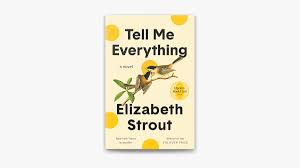
Elizabeth Strout’s The Things We Never Say (Random House, May 5, 2026, longlisted for the 2026 Booker Prize) follows Artie Dam, a fifty-seven-year-old high school history teacher in a coastal Massachusetts town, through the summer and fall of 2024. Outwardly Artie has all the makings of a good life, a thirty-year marriage, a house, a son he is proud of, a beloved career, a sailboat, and inwardly he is desolate. The novel is at once a portrait of loneliness, a study of class and marriage, and a record of a country’s drift toward fascism.
(SPOILER ALERT: this post discusses the novel’s central secret.)
Our conversation began with an admission by several of us that we had read this most recent Elizabeth Strout novel early this summer, then forgotten the details, and had to read it a second time to prepare for our discussion. I suggested that perhaps our forgetfulness was because Strout captures our current political climate so well. But others quickly disagreed with me and began instead to discuss Artie. In retrospect, I wonder whether our forgetfulness may have been rooted in the sadness we felt as Artie, the outstanding teacher of the year, familiar to us, was gradually worn down, deeply depressed.
A chronological plot summary does not do justice to this seemingly simple story of a beloved high school history teacher, a man with a big heart and a love of the sea, who increasingly wonders whether there is such a thing as free will. Strout gives the reader a sense of what is coming for Artie, foretelling his future and then backing up to the present storyline. As a historian, he is acutely aware of his country’s increasing fascism. On the personal level, he is uncomfortable living in his wife’s inherited home on a private street among wealthy neighbors he considers snobs.
He frequently remembers his own parents with love and tenderness. An unforgettable scene in the novel — and a recurring image for Artie — is that of his sister Maria in the cellar of their basement apartment, eating confectioners’ sugar from a jar with a spoon, and his recognition of how hungry she was for sweetness in her life. He feels a tenderness for his mentally ill mother, and we see how that tenderness informs his relations with his most troubled students.
Artie is then confronted by the secrets of his wife, Evie, who lied to him about their son Rob’s paternity, and her relationship with one of their social group, Reginald, an intellectually pretentious man Artie deeply disliked and did not respect. Artie and Reginald’s wife Flossie had a warm but non-erotic friendship.
On his deathbed, Reginald sent a letter to Rob that reveals the affair and directs him to a lab for DNA proof of his paternity. Rob shares the information with Artie, and while their connection strengthens, neither of them ever tell Evie who discovers the letter among Artie’s belongings after he dies.
We all loved Artie as a character, and most of our discussion focused on him: as a teacher, as a parent, as a friend. The novel is too intimate and too timely to be easily labeled with a list of topics, though it is certainly about class, about marriage, about parenting, and about the things that prevent people from really knowing one another, including secrets, a theme we saw in the last book as well.
One difference in this book is that the personal complications are aligned specifically with the disillusionment of a man who has lost his faith and trust both as an individual, in the institution of marriage, and the reality of what one presumes of one’s neighbors or community who he may know are flawed, but does not presume to be as brittle or selfish as they are.
He is a historian whose keen awareness of the ways the country faces real destruction combines with this personal shock to fundamentally shake his core sense of identity.
He is rescued from a sailing accident by a person whose political views are an anathema to him. It is these complications which have always existed and which Strout reveals in their current attenuated state, one that many of us recognize as we also often want to escape.
Midway through our discussion we were joined by a new member, who agreed that she loved the book and plans to come back because of our interesting book list, one co-created by all of us from books we recommended after first reading them.
Stay tuned for our next read: The One Hundred Years of Lenni and Margot by Marianne Cronin