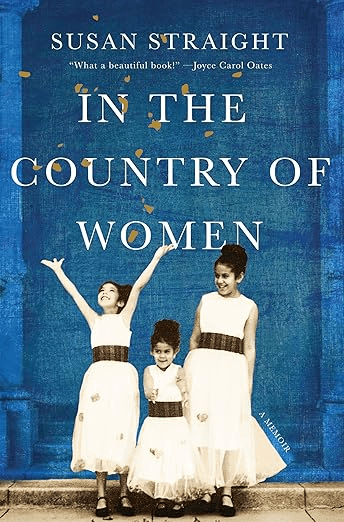
By Susan Straight (2019)
Our lively discussion of Susan Straight’s memoir began with a collective admission that, initially, all of us were overwhelmed by the many ancestors Straight introduced to her daughters and us, until we gave up making lists and let the multitude of stories flow over us.
We were compelled by Straight’s narrative, her lyrical prose, her unabashed delight in being accepted as a fifteen year old white girl into the capacious family of her black boyfriend, and later husband, Duane. We all agree that we are glad we read this book.
After listening to the audible version, I turned to some reviewers’ accounts in The Guardian and the NYT. The reviews pointed me back to the prologue, which I revisited, and which reminded me of the important context in which Straight sets her personal account. I quote:
“The book’s prologue…draws parallels…These are all women who had to contend with abusive systems of race and gender based oppression, who had to fight or flee the abusive men in their lives.”
The women whose stories make up this memoir are an extended family of ancestors, including African American, Mexican American, Cherokee, Creek, Swiss, Irish, French, English, Filipino, Samoan, and Haitian women. Straight has done incredible research, conducted interviews and teased out many of their formerly secret stories. She retells these accounts with respect, often awe, and no judgement. She acknowledges what she does not know, both about facts and experiences, making connections between Duane’s family members and the stories of their ancestors and her own. Straight—and eventually her three daughters—heard for decades the stories of Dwayne’s family’s ancestral women. Some of these women escaped violence in post–slavery Tennessee, some escaped murder in Jim Crow Mississippi. And Straight also shares how her own family of origin reflects the hardship and resilience of women pushing onward—from Switzerland, Canada, and the Colorado Rockies to California.
Although she and Duane travel, live in Amherst during her graduate education, and in New York, the heart of the book and of Straight’s life is in Riverside, California.
She winds her own story in and among the stories of ancestors, leading some of us initially to wish she had written two separate books, but then realizing they actually do work together.
We wondered if she had always yearned for a large, extended, family such as Duane’s, and if, as their three daughters grew and eventually all moved far away, she wanted them to know and hold onto that life in Riverside, the big family gatherings when the men filled the driveway and grilled the meat and the women cooked lavish feasts in the kitchen. Accounts of the ribs and casseroles, children playing, dogs barking, and radios blasting music are filled with joy and delight, and celebrate survival against histories of violence. Straight writes of her daughters:
The daughters of our ancestors carry in their blood at least three continents. We are not about borders. We are about love and survival.
Finally, we noted with surprise the threads among our very different recent readings. For example, Straight’s mentions of Joan Didion reminded us of the exchange of letters between Sybil and Didion in The Correspondent. We talked about how the stories of ancestors resonated with Sybil’s experience with DNA testing and with Alma’s buried manuscripts in the Cemetery of Untold Stories. And, following from Hamnet, we talked about each of the novel’s explorations of parental grief in the face of the death of a child. Ultimately, we see Straight’s memoir as a love letter, not only to her daughters,but to all those whose survival made possible the extended family in which they flourished.
 Ruth O. Saxton