Cat Brushing by Jane Campbell 2022
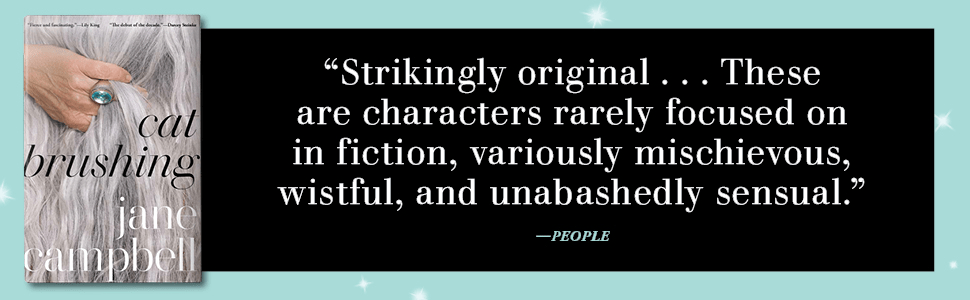
In her debut collection of short stories, Cat Brushing, 80-year-old British author Jane Campbell aims to set the record straight about “women of a certain age.”
I will share from the The San Francisco Chronicle review of the collection at some length, as I found it useful context, and you may as well:
what began in 2017 as an impromptu sketch piece inspired by a two-week holiday in Bermuda with her eldest son and daughter-in-law turned into a no-holds-barred collection of 13 dirty, doughty and often wickedly funny stories that cover everything from common misconceptions about aging (no, grandmothers aren’t only there to serve their grandchildren, and, yes, their thinking processes can be just as deep and nuanced as they were at a youthful 30) to erotic desire (or the long-overdue liberation from sexual obligation) to retaining agency as “an oldie.” The best part? They’re all narrated by mouthy women who are through with being patronized.
This, like most of the reviews I read, suggest the collection is rather delicious fun, using terms such as “wickedly funny” or “delightfully shocking.” However, upon reading the collection I was struck that many of the stories offer a pattern that is far darker: elderly female characters finally do what they want, which feels cathartic and empowering but only briefly, as most of the stories close bleakly, with the women bound under the judgment of others.
I wondered how we would respond, given our status as elderly readers,some of us older than Campbell when she published the stories about women in our age cohort.
I had purchased the hardcover copy soon after its publication, but set it aside and so listened to the stories because of my macular degeneration. Then, at our meeting, I had trouble getting onto the zoom link and missed the first part of group discussion. Discombobulated by the problems, I forgot to take any notes.
However, in response to my plea for help, Diane, Annette, and Patricia provided excellent notes, making it possible for me to give you a glimpse of our group’s responses to the collection.
At least three of us did not like the collected stories overall, but altered our dissatisfaction as we listened to other group members. One common complaint was the recurrence of abrupt negative endings that overwhelmed what had been a generally positive or capacious take on the older woman’s experience.
Many of us noted the ways the collection demonstrates how traumatic childhood experiences, such as incest or extreme emotional distance from a parent, do not disappear with age.
We also noticed that Campbell kept our focus on the elderly woman’s experience by providing indirect clues rather than didactic explication or description, and that these clues got us thinking about the likely relationships between the character and significant people in her life.
Some of the most shocking stories portray women choosing dramatic deaths–from cutting in the bath to be discovered by visiting adult offspring who are more distressed by the mess than the loss of their parent to the suicide of a woman whose youthful affair has remained the love of her life in memory but was just a fling for the man she has stalked. These stories prompted conversations about the potentially stark differences between individual memories of events and the pain that such differences can cause.
We appreciated the tender story that opens the collection in which Susan, a bedridden elderly woman is ready for death until she unexpectedly experiences desire for Miffy, the young caregiver and rediscovers the importance of touch. We were struck by how the story’s description of loving touch, outside the “norms” of traditional erotica or caregiving, contrasts to the superficial programmed way of caring portrayed by others.
We were somewhat amused by the Schopenhauer story’s ending in which the woman manages to destroy her robot caaretaker, and we discussed this hostile substitute for human companions and helpers. Those of us who had read Ishiguru’s Klara and the Sun noted the strong contrast with Kim and Klara, yet how both were designed to be a companion for a lonely human.
We speculated that Campbell’s long career as an analyst may have influenced her fictional portrayals. I had purchased her first novel, published two years after the short story collection, and after our discussion I found it in my library. Freudian analysis plays a central part, and is nearly a character of its own, both in that novel and in Cat Brushing. In the end, we agreed that, Campbell’s text provokes thought, if not pleasure.
.A link to the titular story from London Review of Books: https://www.lrb.co.uk/the-paper/v39/n21/jane-campbell/story-cat-brushing
 Ruth O. Saxton