Winter/Spring 2025 Downtown Oakland Senior Center Book Group with Dr. Ruth Saxton
Thanks to Carole Glanzer for organizing!
Thanks to Carole Glanzer for organizing!

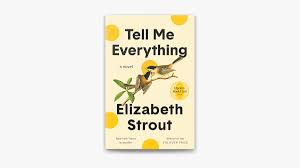
“A generous, compassionate novel about the human need for connection, understanding and love, and the damage that occurs when those things are denied.”—San Francisco Chronicle
Elizabeth Strout returns to the town of Crosby, Maine, and to her beloved cast of characters — Lucy Barton, Olive Kitteridge, Bob Burgess, and others. In this novel, the community must navigate a shocking crime in their midst.
Our book group previously had read Strout’s Olive Kitteridge at my suggestion. I had taught the book at Mills, and the students found the stories engaging and thought provoking. The book group agreed, and we eagerly returned to Strout’s characters in Olive, Again, Oh, William, and Lucy by the Sea, so when we saw the announcement of Tell Me Everything, we immediately added it to our fall 2024 reading list. We anticipated Strout’s familiar conversational style, her quirky characters, with a central plot threading together all the bits and pieces. dWe were surprised by the larger cast of characters, the multiple plot lines, and we were a little disappointed.
We had not been put off by large casts of characters or multiple plot lines in other books, and we wondered why this book, well reviewed as the Chronicle quote above indicates, did not sit well with us.
Perhaps we expected her more familiar form. Unlike novelists whose books do not return to the same places or characters, Strout’s connected novels, while not formally a series, create a fictional world that invites readers to return to a place they know well, offering new surprises and plots but within an expected structure. So the shift in structure, as it did not have a clear point–was not obviously making an argument via form–put us off a bit.
We also had feelings about the characters’ fates. We have leaned into novels with tragic or or unhappy outcomes, but here we were invested in the characters across a series of stories, and so our reactions and expectations differed. Perhaps we were perplexed by the choice to make Lucy remarry William, whom none of us really like. One group member wondered why she built up the intimacy between Lucy and her friend Bob Burgess only to alter it so abruptly. We speculated that Lucy married William to force herself to loosen the ties to Bob. Our reaction, as if these are people we know, is fascinating to consider. For example, long after my initial reading and weeks after the group discussion, I still feel the initial burst of satisfaction I had when Olive’s good friend in the memory care section of their shared nursing home defied her daughter’s insistence to move across the country near family and insisted she needed/wanted to stay close to her best friend, Olive.
Strout’s characters always feel “real,” and her writing is always strong, but I wonder about the dangers of writing a series of linked novels, as well as the pleasures. I did not, finally, enjoy this novel nearly as much as the previous ones. I’d love to know what you think!
Remarkably Bright Creatures by Shelby Van Pelt (2022)

Shelby Van Pelt was inspired to write this novel after viewing the underwater documentary My Octopus Teacher. The novel focuses on the friendship between an octopus and a seventy year old widow whose eighteen year old son has mysteriously disappeared while on a boat trip decades before. After her husband’s death, Tova takes up night shifts mopping floors and tidying up at the Sowell Bay Aquarium where she becomes acquainted with Marcellus – a curmudgeonly giant Pacific octopus living at the aquarium. The book begins with narration by the octopus, named Marcellus McSquiddles—much to his chagrin, for he is not a squid. Marcellus complains about his captivity as he approaches the end of his lifespan, and he introduces us to the aquarium and the night shift cleaning woman, Tova.
Like the readers who made the novel a bestseller, our group praised the novel as heartfelt and uplifting. The deft shifting first person narration made us really care about its characters . We appreciated its somewhat improbable but hopeful ending that, in the way of a Victorian novel, ties up all the loose ends. Readers in our group lightly criticized the somewhat ageist stereotypical depiction of Tova who lacks the technical skill we all have as seniors who meet over zoom and are deft with cell phones, computers, and ipads. We cringed a bit at the title of her group of friends, “the knit wits” even though it was based on their initial formation as a knitting group.
That said, we all agreed we loved the novel anyway. Our favorite character was Marcellus, and the friendship we most admired was that between Tova and Marcellus rather than her group of slightly zany friends. Some of us share Tova’s Scandinavian stoicism, social reticence, and need to be busy, and we admitted that despite our technological skills, we often identified with her. We wondered at first why she took the laborious night job, but then an insightful reader of Scandinavian heritage reminded us of Tova’s desire for privacy and avoidance of gossip, unlike the gossipy owner of the convenience store, Ethan, whose penchant for news contributes to the plot as much as his fondness for Tova.
I highly recommend this enchanting novel. You will never again see octopus as you do prior to meeting Marcellus. In fact, one of our members admitted she has replaced her original dread of octopuses with a new fascination for their brightness.
The Heaviness of Things That Float (2016)
Jennifer Manuel

This book was difficult to find. We could not find copies in local libraries, but group members managed to obtain copies nevertheless as Carole’s note describes, in a brief anecdote that reminds me of the connections we make by reading together, connections that Bernadette, the protagonist of this novel, longs for:
“Linda and I live just a few minutes’ walk from each other and we’ve shared books for our group before. Usually, I’d finish and pass the book on to Linda, but this time we had a more elaborate arrangement. I found that I had no time to read during the day, so Linda had the book during the day and I had it overnight, since I seem to have quite a bit of awake time during the night these days. Mostly, we left the book for each other, inside my front gate or at Linda’s front door. Sometimes we met up for the exchange. It was fun to check in about where we were in the book and what we thought about what was going on. “
I was unable to access the book in an audio version; I had ordered a copy from a local bookstore, hoping I might be able to read parts with my magnifier, but it had not arrived by the time we met. So my contribution was simply a quote from one of the novel’s reviews I was able to access online. I quoted Carrie Breck’s Blog to open the discussion: “A truly conscientious writer brings first-hand experience, research, and timeless understanding, to a relevant issue. For this reason Jennifer Manuel’s 2016 debut novel, The Heaviness of Things That Float is well worth talking about.”
And talk we did, in a rich discussion led by Diane Anderson, who first suggested this book that touches on so many important topics. Diane writes:
There are 4 main themes in the book, as seen through the characters. They are starting over, loss, belonging, and the depiction of the indigenous community. The main character, Bernadette, has worked for 40 years as a nurse and is about to experience the loss of her job and identity: ‘Nobody could wholly know the heart of another, no matter which side of the unbalanced world we live in’ (284). Bernadette longed to belong to the First Nation community, but the Tawakin people still considered her an outsider. Her only sibling, her sister has recently died and left her a home on the mainland. She has rejected her former lover, Frank as a partner and has lost Chase Charlie, Frank’s biological child whom she loved. The author insists on people’s dignity and humanity in the face of unflinching sorrows (alcoholism, abuse, poverty, suicide).
The novel contains beautiful prose, describing the reservation as a community where stories are
like organisms all their own, life upon life, the way moss grows around poplar trunks and barnacles atop crab shells, the way golden chanterelles spring from hemlock needles. They spread in the cove with the kelp and the eelgrass, and in the rainforest with the lichen, the cedars, the swordferns. They pelt down inside raindrops, erode thick slabs of driftwood, puddle the old logging road that these days led to nowhere.
I am sorry I could not read all of this evocative novel, but am lucky to have been introduced to it so well by this group of excellent readers. The novel reminds us that there are many sorts of community, and how important attentive belonging is.
Welcome to the Frog Hospital
Lorrie Moore (1994)
Lorrie Moore was wandering through an art gallery when she came upon a painting called “Who Will Run the Frog Hospital?” The work, by Nancy Mladenoff, depicts two young girls regarding a pair of bandaged frogs. Ms. Moore not only bought the painting, she also borrowed its title and imagery for her second novel.
The novel is narrated by Berie Carr. While vacationing in Paris with her husband, Berie recognizes that her marriage is deteriorating, noting that “I feel his lack of love for me. But we are managing.” Facing this disappointing state of adulthood, the book narrates her recollections of an adolescence in Horsehearts, New York. Berie looks back to 1972, when she was a wild teenager with her best friend Sils. They had summer jobs at Storyland, an amusement park where Sils plays the part of Cinderella and Beris works as a ticket seller. The emotional heart of this short novel is the intense friendship between the two young women. Berie is nostalgic
for that summer in which she felt so alive: smoking and drinking and sneaking out, the passionate connections, the fearless quality that is so yearningly absent in her life as she approaches forty with a philandering husband and no zest for the present.
Moore’s precise period details take us to a specific moment in American history: the music, the styles, even the lip gloss, are familiar to readers who grew up in that time. As is the political climate, the illegality of abortion in much of the country, the gendered assumptions.
In our discussion, we differed widely in our response to the book. I was perhaps the most negative, confessing my disappointment in reading such a negative, hopeless account of a narrator less than half my age who yearns with such nostalgia for a lost adolescent exuberance and girlhood friendship but who, at not even forty, in good health, has so much time left, so much she can do, can choose. I wanted her to get a life in the present, to develop underdeveloped aspects of herself.
Other members of the group enlarged my appreciation of the novel, describing it as sad, and quite accurate to how it can feel in middle life, to be stuck, not in the adult life one imagined, and yearning for a romanticized intense lost youth. One reader commented that if the marriage is hopeless, Berie may leave it and that she probably has decades of new experiences ahead of her. Another reader read us the narrator’s description of singing in a girls’ choir and noted the magic and hope contained in that uplifting passage. Some readers and reviewers enjoyed tagging along with a narrator through memories of a youth so much more wild than their own, particularly when we are not troubled by the fear she will not survive it.
It occurs to me that we really reacted to Berie as a person, or a cipher for the author, rather than a character designed by Moore to show us a set of emotions and memories. And that response speaks to Moore’s success as a writer. I will end with a couple of examples of her precise and powerful prose:
On her husband:
[H]e studied Spanish once, and now, with a sad robustness, speaks of our childlessness to the couple next to us. “But,” he adds, thinking fondly of our cat, “we do have a large gato at home.” “Gâteau means ‘cake,'” I whisper. “You’ve just told them we have a large cake at home.” I don’t know why he always strikes up conversations with the people next to us. But he strikes them up, thinking it friendly and polite rather than oafish and irritating, which is what I think.
On femininity:
I remember thinking that once there had been a time when women died of brain fevers caught from the prick of their hat pins, and that still, after all this time, it was hard being a girl, lugging around these bodies that were never right – wounds that needed fixing, heads that needed hats, corrections, corrections.”
After listening to our animated discussion about the plot, the character, and the writing, a reader who had lost interest in the novel and set it aside decided to finish reading it.

Dinners with Ruth: A Memoir on the Power of Friendships (2022)by Nina Totenberg was our selection for September 23rd. Lauded National Public Radio legal affairs correspondent Totenberg’s book chronicles her almost half a century long friendship with Supreme Court Justice Ruth Bader Ginsburg. We enjoyed the book, although it lacks the personal detail, or first hand sense of intimacy, or sensory granular texture we realize we expected from a memoir (rather than say a more formal biography).
In her September 13, 2022 review for The New York Times. Susan Dominus describes the book as:
a loosely organized account of her [Totenberg’s] own life, and the role of Ginsburg (among other friends) in it, has a genial, likable tone. Totenberg’s stories are lively but never go on too long; she appears to reflexively turn the reader’s attention to the generosity or small kindnesses of others. She writes, without pretension or self-congratulation, about moments of journalistic triumph of which she has every right to be proud. She is also unfailingly discreet, a quality that the reader must concede reflects well on her as a friend. It serves her less well as the author of a memoir whose most central character, outside of Totenberg herself, is one of the most influential, fascinating and, to some, frustrating women of the last century.
My recent inclusion in the Senior Center’s creative writing/memoir Zoom group provided by Litquake informed my own awareness of the ways in which memoir draws on fictional techniques and differs not only from scholarly writing, my usual form, but also differs from journalism. We realized that we could get more information about Ruth Bader Ginsburg from other sources, and that while we enjoyed the historical information and personal touches, we wished either for the book to be more of a memoir or more of a biography.
However, we all found the book generally enjoyable. Totenberg’s journalistic skill provides the reader with lots of information, and her account of friendships and the tending of friendship is an important reminder for readers of any age. As seniors, Totenberg’s discussion of the past reminded us of historical times we also experienced. And we enjoyed the behind the scenes observations of members of the Supreme Court, Tottenberg’s colleagues at National Public Radio, and the accounts of friendship networks in Washington, D.C.
The personal bits were most powerful for us. Totenberg’s most moving stories are about how the two women helped one another through the grave illnesses of their husbands. The reporter’s first husband was the late Senator from Colorado Floyd Haskell, a man 26 years older than herself, who died after they were married for 15 years and she shares the advice and wisdom Bader Ginsberg offered her during that difficult time, notably to tend to her work and not lose herself in endless days of waiting in the hospital.
We all agreed that while we are glad we read it, we wished to learn more about both Totenburg and Ginsburg than this very discreet book offers.

Tille Olsen’s Tell Me a Riddle, Requa I, and other stories
Our September 9, 2024 Book Group discussed Tillie Olsen’s Tell Me A Riddle, a collection of four short stories first published in a slim book in 1927. All four stories were featured in Best American Short Stories, in the year each was first published in a literary magazine. The title story was awarded the O. Henry Award in 1961 for best American short story. The group had read Tillie Olsen’s short story “I Stand Here Ironing,” before, and were excited that a member suggested this collection as a chance to read more of her work.
Let me digress a bit here to describe how the book list selection process has evolved. I chose the selections initially, drawing on stories assembled in my Book of Old Ladies that had been favorites in my courses at Mills College. We maintained the theme, focusing on “women of a certain age” as the main characters.
Eventually the entire group participated in proposing books, pitching them and then taking a vote. We considered broadening the theme, and read several books by men, opening the genre to include essay collections by Ursula LeGuin and Ann Patchett, and then returned to our initial theme of old women but maintained the inclusion of essays and memoirs.
We now limit recommendations to two per member and then vote, trying to select one from each pairing. Sometimes several members agree on a single book, and reduce the list prior to a final vote. Then I create the order of books, taking into consideration length and topic. We read or listen to the longest books over the lengthy break between series.
We have also changed our discussion format. Initially I assembled a list of open-ended questions and led discussion. Later, various members took turns creating the questions and leading the discussions. Now we each show up with an observation or a question, usually sharing a few sentences from the text that either delighted or confused us.
Back to Tell Me a Riddle. In advance of the discussion, I wrote a bit about my responses to the stories, and my connections to and responses to Tillie Olsen. Tille Olsen’s writing introduced me to many writers of what we began to call Working Class Literature; the Feminist Press began to publish some of the then out of print works she brought to light. When I was a student in UC Berkeley’s graduate program. I invited her to a graduate course on California Women Writers, where her work was not included. Later, I invited her to read aloud “I Stand Here Ironing” at Mills. Olsen reminded me a little of my mother, also an Olsen, also a working class woman, a maid, raised to be a wife and mother, writing poetry on the backs of envelopes and grocery receipts. In Silences, Olsen accounts for the years between her literary outputs: “She did not write for a very simple reason: A day has 24 hours. For 20 years she had no time, no energy and none of the money that would have bought both.” Both Tillie Olsen’s life and my mother’s contrasted starkly with university culture, and after meeting Tillie Olsen I wanted my Mills students, especially those first generation students like me, to be encouraged to write their untold stories.
In our group, everyone had much to offer about their own connections to Olsen’s work. A librarian in the group considered the implications of the subject headings under which the collection is listed in library’s catalogs. Another member who was familiar with the names Jack and Tillie Olsen from her family’s connections with the Longshoremen Union told us about the housing cooperative Tillie Olsen and her husband helped establish in the Western Addition. Our discussion included close analysis of the prose and general discussions of class and race, of mothers and daughters, of the “sorting” that occurs among children as they move into middle school. We all learned something beyond our own initial reading, and it was one of the richest discussions we have had.
Several people read the most recently published version from the University of Nebraska Press that includes not only the 4 stories but also a longer piece of writing, Requa, perhaps her most experimental work, some of her political articles, and several wonderful critical essays by family members, daughters Laurie Olsen and Julie Olsen Edwards and a stellar introduction by her granddaughter, Dr. Rebekah Edwards, a long time visiting professor at Mills as well as an alum and a dear friend of my daughter, Kirsten. I highly recommend reading Tillie Olsen’s work, and if you can, reading this edition.
Virginia Woolf’s To the Lighthouse
Our second August discussion focused on a book I recommended because it is my favorite novel by Virginia Woolf: To the Lighthouse (1927).
While it is less than half the length of The Stone Diaries, it is a lyric and non linear novel, an early example of a stream of consciousness narrative. After completing Carol Shield’s fictional account of the multiple decades of Daisy Goodwill’s life, we read Virginia Woolf’s fictional account of the Ramsays based closely on her parents, particularly Julia Stephens, in which the life is squeezed into an account of a single day, a death recorded in parentheses, and a rendering of the ways in which Mrs. Ramsay’s legacy lingers in Lily’s mind. Both novels confront the reader with those not so simple questions: What is the meaning of a life? And what does it mean to “know” another person?
To the Lighthouse is a book in three parts, in three movements. All of it is laid at the Summer home of an English family named Ramsay in the Hebrides, the first portion occupying an afternoon and evening, the second portion constituting an interlude of ten years during which the house remains unoccupied, the third portion occupying a morning at the end of these ten years. The Ramsays are a middle-aged couple, when the book opens, with eight children, who have with them at their Summer place about half a dozen friends including the young unmarried artist Lily Briscoe. Woolf uses the figures of Mr. and Mrs. Ramsay as the archetypal marriage, and the eccentric unmarried artist, Lily Briscoe, to engage ideas about gender relations, marriage, war, home, meaning, truth. Woolf uses stream of consciousness—a style of writing meant to mimic the way thoughts flow through people’s minds.
Most of the books we choose are plot driven, moving through time in a linear fashion, chapter by chapter, often with one point of view, or sometimes a sequence of chapters is narrated by separate characters. In contrast, Woolf’s stream of consciousness moves inside and outside characters’ heads, forward and backward in time, and the vivid prose and imagery is similar to that of poetry.
I began receiving emails from members who were struggling to finish the novel. I shared notes from my teaching days, introducing stream of consciousness and some critical reflections on the novel, hoping to convince everyone to love one of my favorite books. While I did not convert everyone to Woolf, the discussion was animated, and we all appreciated hearing each person’s remarks.
Coming away from the novel, we were left with its essential question: What is the meaning of life? Mrs. Ramsay repeatedly asks the question in Part I, and in Part III, trying to finish her painting of Mrs. Ramsay, Lily echoes it:
What is the meaning of life? ‘That was all–a simple question; one that tended to close in on one with years. The great revelation had never come. Instead there were little daily miracles, illuminations, matches struck unexpectedly in the dark;…Mrs. Ramsay saying, “Life stand still here”….In the midst of chaos there was hope; this eternal passing and flowing.
As Lily ponders the impossibility of ever really knowing another person, she thinks of the habit we all have of making up scenes about others based on bits and pieces “what we call knowing people,” and realizes there are no guides to answer the question about life’s meaning, but rather that “so much depends upon distance: whether people are near us or far from us….”
As Lily continues and eventually completes her painting, her vision of Mrs. Ramsay, she thinks: “One wanted fifty pairs of eyes to see with…Fifty pairs of eyes were not enough to get round that one woman with” and as Lily finishes her canvas with a single brush stroke, Woolf ends the novel with Lily’s words “I have had my vision.”
The Stone Diaries by Carol Shields
Just before the pandemic, I first discussed a selection from my Book of Old Ladies with seniors at the Downtown Oakland Senior Center, meeting in person in a large ballroom where over 70 seniors met with my small Mills seminar of 15 students to discuss Toni Cade Bambara’s short story, “My Man Bovanne .” We intended to meet monthly at the center, but after our second meeting to discuss “They May Not Mean To, But They Do,” the pandemic precluded meeting in person and we turned to Zoom, then a startling new technology for most of us.
Going forward, I intend to use this blog to update you on our current readings in the hopes that you may find the books and discussions of interest!
Since we have already met twice (life does show up in the way of good intentions as we all know!), we have had two sessions already this season, and so I will start with a brief account of of these and give you a heads up on what follows in case you want to read along with us.
On August 11, we discussed Carol Shield’s 1993 novel, The Stone Diaries. We selected this novel because of its importance to the member who originally recommended it and said she found it a good companion during the long days she sat by her dying father’s hospital bed
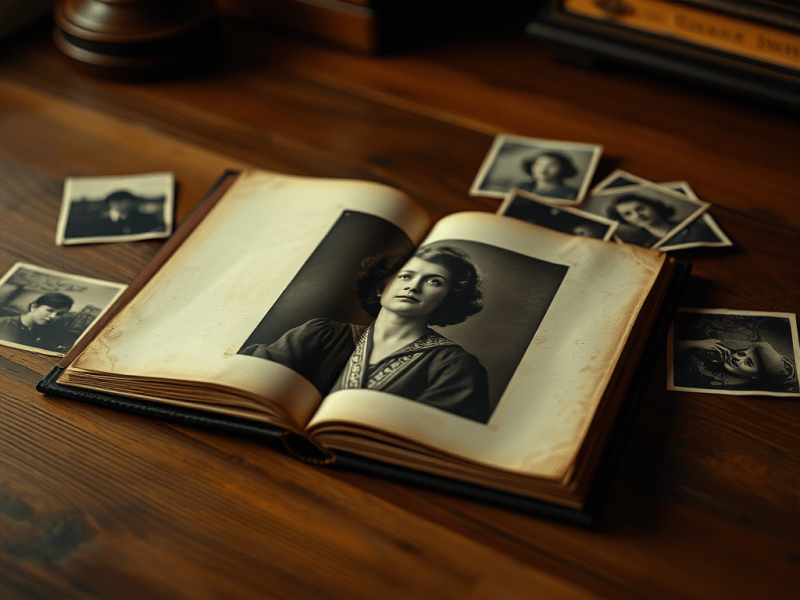
The novel is a fictional autobiography which follows the life of Daisy Goodwill from her unusual birth to her quiet death, drawing on diaries, letters, newspaper articles, and other “real life” materials to document the life of an ordinary woman. While I need to listen to books because of my vision, I purchased a second hand copy of the novel so I could see the photographs included in this facsimile of a biography, and I was interested to learn Shields used photographs of her own children to represent Daisy’s three children and drew on vintage photographs purchased in thrift shops to represent the other characters.
Shields commented that with this novel, she finally wrote the book she wanted to read: one in which an ordinary woman, with no astonishing or heroic accomplishments, lives day to day, primarily in family and domestic settings. Daisy Goodwill Flett’s life is marked by death and loss from the beginning, when her mother dies during childbirth. Through marriage and motherhood, Daisy “struggles to understand the paradoxes of her life” (The New York Public Library), and the book is divided into ten chapters detailing each epoch of Daisy’s life.The Stone Diaries won the 1993 Governor General’s Award for English language fiction in Canada and the 1995 Pulitzer Prize for Fiction in the United States.. It also received the National Book Critics Circle Award.
Our discussion of Stone Diaries was unusual in that readers had no questions about difficult passages. And few had marked favorite lines to share with the group, although we agreed that the writing was excellent. Perhaps because Daisy’s life felt familiar with its domestic every day focus, despite some of the tragic details of her experience. The narrator’s descriptions of Daisy are always from the outside, never probing her interior. The arc of the novel did not lead to dramatic lows and highs; rather it, like life, echoed the rhythms of ordinary life–its intended purpose. By the end of our discussion, nearly everyone mentioned intending to read the novel again with an altered sense of expectations,, and commented on how the novel mirrors most lives, one incident follows another without building up to a crisis or tying up loose ends with a bow.
Tune in next week for Virginia Woolf’s To the Lighthouse.

 Ruth O. Saxton