Like many authors who published books in 2020 and as a professor for over 42 years, I’m particularly looking forward to sharing my work and connecting with readers in person next Saturday (you can RSVP here). The video above is from one of the first in-person readings I gave in November 2023 since The Book of Old Ladies was published.
An Update
As I printed the reading list for my upcoming Book Group for the Downtown Oakland Senior Center, I reflected on our beginning as a collaboration between the DOSC and my final post-retirement English Department course at Mills College, “Coming to Age.” What began as monthly in-person sessions between undergraduate Mills students and members of the DOSC transitioned to Zoom sessions due to the Covid pandemic. No longer a collaboration after the end of the spring semester 2020, the DOSC readers decided to continue meetings on Zoom, taking summer and mid-winter breaks between sessions. We discussed 37 books between 2020 and 2021, chosen by me as an extension of my book, The Book of Old Ladies, in which the protagonists are all women over sixty. Currently, the selections are chosen together with members of the group.
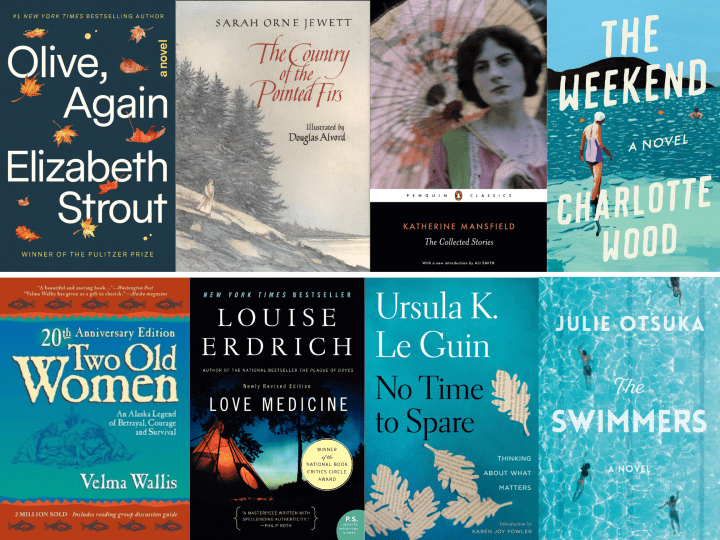
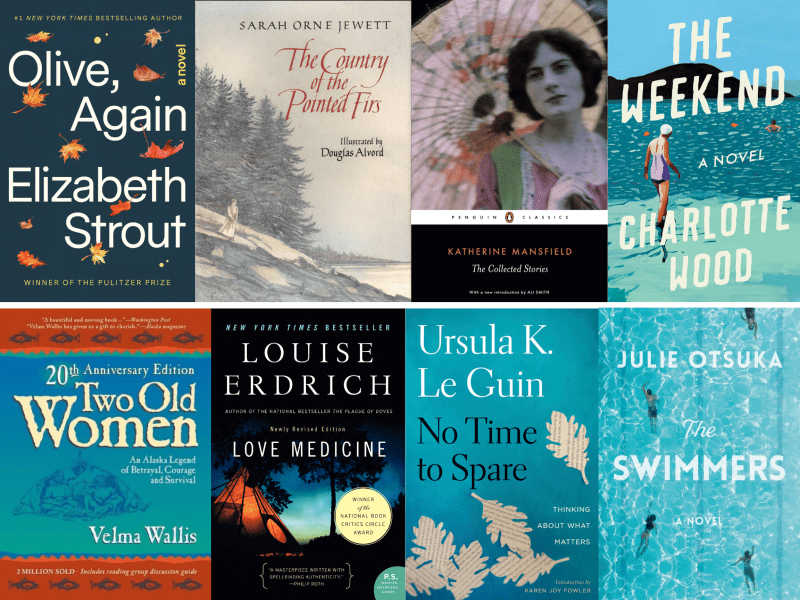
I took a break from social media this summer and fall, and I have recently been asked for an update on the books we read in our summer/fall 2022 session. They included short stories, novels, and essays. Here they are:
We enjoyed “Olive Kitteridge” and returned to Elizabeth Strout with “Olive, Again.” The collection of stories follows Olive into her old age and home into assisted living with the lively characterization and detailed sense of small towns in Maine we had earlier enjoyed.
We then reached back to the nineteenth-century portrayals of elderly widows by Sarah Orne Jewett. “The Country of the Pointed Firs” is also set in Maine.
Two short stories by Katherine Mansfield featuring three generations in an Australian setting rewarded us next: “Prelude” and “At the Bay.”
We then read Charlotte Wood’s 2022 novel, “The Weekend,” also set in Australia, in which three elderly women friends meet at the ocean cottage of the deceased friend to clean out her belongings and face their future without their beloved friend, who often was the glue that held them together—also discovering long-held secrets.
Louise Erdrich’s much-celebrated novel, “Love Medicine,” was a tough read. However, her prose is lovely, exposing the anger, desire, and healing power that is love medicine within this first novel in her Native American series.
Ursula Le Guin’s late-in-life collection of essays, “No Spare Time,” was our first non-fiction reading. It brought laughter of recognition in her short essay that gives the book its title and awe for her wisdom, and we determined to include one of her novels in our first 2023 session.
We concluded with Julie Otsuka’s short contemporary novel, “The Swimmers,” written in a “we” voice and moving from an underground community swimming pool to life in an assisted living residence. And we just decided to include one of her earlier historical novels in the next session.
When we first adjusted to Zoom sessions in 2020, we had no idea we would continue in my retirement, using zoom and appreciating the chance to see each other’s unmasked faces on the screen.
Ageist Harm
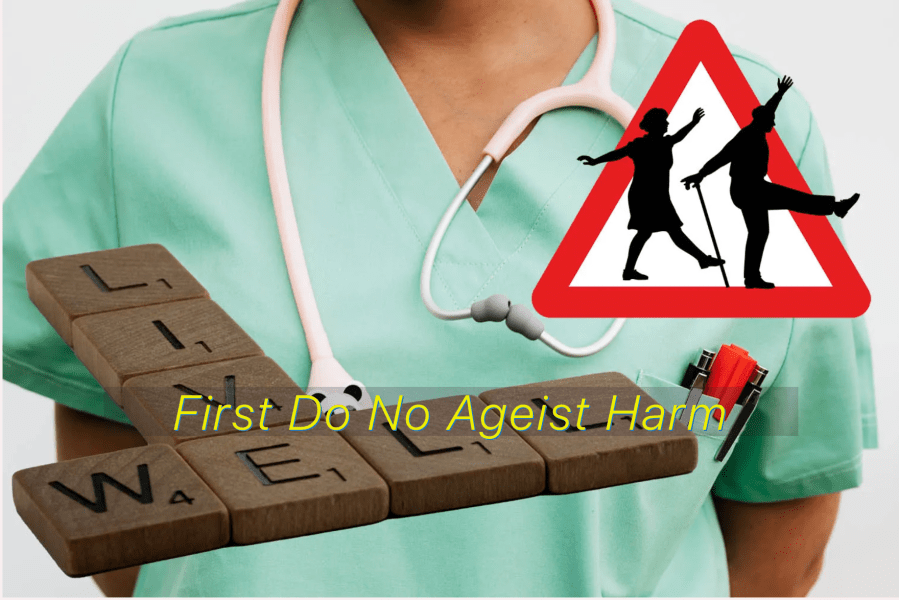
Stella Fosse’s most recent blog posting, “First Do No Ageist Harm,” examines the underlying assumptions of a study on brain health in which she participated because she wanted to contribute to research that would help develop treatments for brain disorders. In her lucid account, she reports that many of the questions came from underlying assumptions she considers ageist–assuming decline, for example. There were no questions about the positive aspects of aging, suggesting there was no financial incentive similar to that of drug companies seeking cures. I had recently revisited Ursula K. Le Guin’s collection of short blog-like pieces written in her eighties and nineties, entitled No Time to Spare in which she begins by referencing a questionnaire she received from Harvard, sent in advance of the sixtieth reunion of her 1951 graduating class. Her response to a question about what she does in her spare time, like the questions Fosse mentions, reveals the underlying ageism of the questions. I suggest you read all four entries in the opening section, “Going Over Eighty.” I love her response that she has no spare time because her time has always “been occupied by living.”
Next, I plan to follow up on Fosse’s recommendation of Becca Levy’s book, Breaking the Age Code: How Your Beliefs About Aging Determine How Long and How Well You Live. Like LeGuin, I bristle when someone claims I don’t look my age, sharing her sense that we earned our wrinkles and age spots in over eighty years and we don’t want them to deny our experience of living.
Betty White
What a wonderful piece by David Von Drehle on Betty White, “The enduring, aspirational appeal of Betty White“.
She was and is, “an aspiration, for people who not only want to live long, but want to live better. To live with love, forgiveness, kindness and hope.”

On Older Women’s Stories
Read my interview with Stella Fosse, “Into Your Eighties Joining Hands Across Generations“, on her blog.

The Wisdom of Age
Sky blurbed my book, and I love her work. Watch her new documentary Lives Well Lived on PBS or buy yourself a copy.
You can stream Lives Well Lived on Amazon, iTunes, and PBS Passport. The DVD is also available on the Shop PBS website and is the perfect holiday gift.

Excerpt in the Feminist Book Club!
“Life after sixty can be wonderful and surprising, and coming to age can be profoundly satisfying.”

Review in WOW: Women’s Older Wisdom

Please check out this wonderful review of The Book of Old Ladies and the terrific blog site, WOW: Women’s Older Wisdom.
I so appreciate this conversation, and very much enjoyed guest attending Pat’s class and hearing her wisdom and that of her amazing students whose stories moved and inspired me.
Interview in the Mills Quarterly
I am really pleased with this wonderful article about “The Book of Old Ladies” & my spring class Coming to Age with Mills students and elders from the Downtown Oakland Senior Center. I love its inclusion of so many Mills voices!

Professor Emerita Ruth Saxton offers alternate visions for “coming to age” in The Book of Old Ladies
By Dawn Cunningham ‘85
In her new book, Professor Emerita Ruth Saxton delves into the complex fictional worlds (and goes beyond the stereotypes) of elderly women.
Interview with Christine Hyung-Oak Lee in “The Rumpus”
“The more I read, the more I appreciate stories in which old ladies not only survive the huge losses of their lives, such as divorce, death of a spouse, serious illness, forced retirement, or alienation from adult children, but discover undeveloped parts of themselves, sometimes defy limiting conventions and habits that no longer serve them well. Stories of satisfying lives after loss lift my spirits and affirm what I have observed not only personally but also in life writing—in journals, diaries, biographies, and memoirs”
Interview with Christine Hyung-Oak Lee in “The Rumpus”