Three Things About Elsie Joanna Cannon (2018)
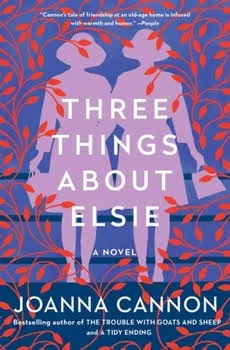
There are three things you should know about Elsie. The first thing is that she’s my best friend. The second is that she always knows what to say to make me feel better. And the third thing…might take a bit more explaining.
Eighty-four-year-old Florence has fallen in her flat at Cherry Tree Home for the Elderly. As she waits to be rescued, she thinks about her friend Elsie and wonders if a terrible secret from their past is about to come to light. If the charming new resident is who he claims to be, why does he look exactly like a man who died sixty years ago?
Booklist describes the novel as
a tender and charismatic look into life in a nursing home. Cannon effortlessly captures the home’s slow routines, along with the ways that staff and residents coexist but often know little about each other . . .
When we met on Monday afternoon to discuss this novel, we all agreed we were glad we read it, but, perhaps predictably in a novel that focuses on the confusions of memory and truth, each of us had questions about the actual facts of the plot.
We were not all sure what was actually “the truth” about Elsie, or about Florence, and we differed about certain “facts” in the novel about the past.
Spoilers ahead! Don’t Read if you don’t want to know what happens!
**************************************************
For example, we asked each another: When did it first become obvious to you that Elsie was not a resident of the home? When did Elsie die? Did she die in the fire Florence mistakenly believed she had caused?
Several of us realized Elsie was not present in the retirement residence but did not realize she died in the fire. We all knew Elsie was Florence’s best friend, that they were very close friends, but not that Flo’s only love was Elsie, that after Elsie died, Florence never married or had children because she, Elsie, was her true love.
We talked about the retirement home, our own determination to avoid such places if possible, the patronizing tone of Miss Bissel and Miss Abrose toward the residents, the tendency to disbelieve those who are forgetful and tending toward dementia.
We agreed that Cannon’s characters–both residents and staff–were believable and well drawn. We praised her handling of the braided plots, Flo’s memories as well as the mystery plot. We appreciated the writing, and all of us had favorite lines, too many to record even with the help of post-its or underlining.
The ending felt forced for some of us. Rodney’s arrest after so many years, the likelihood that he would end up at the same retirement home as Florence after so many decades. And that he would have access to her flat in his attempts to undermine her testimony about the past by accentuating her dementia.
We speculated about the significance of the jet black amulet Flo notices beneath the baseboards from her fallen position on the floor.
We recognized the plot resembles what I label “deathbed bookends” in my book of old ladies, and yet we did not want to critique Cannon as we hadSusan Minot for using this plot structure. After a bit, we realized Minot had placed as the emotional center of her novel an unrequired sexual encounter from the protagonists’ past whereas Cannon provided a much fuller portrait of Flo’s current life and explored the aftermath of trauma.
Around the edges of our focus on the novel, we exchanged some of our own experiences: from visiting family members in such retirement homes, to differentiating between dementia and normal cognitive lapses, to experiences being patronized by younger people who call is by diminutive labels or refer to us in third person.
We liked Flo, and we wondered when she began considering Elsie was present, when Elsie was part of herself. Was the third thing about Elsie that Elsie had died? Was it that she loved Elsie? What do you think?
 Ruth O. Saxton