By Janet Burroway
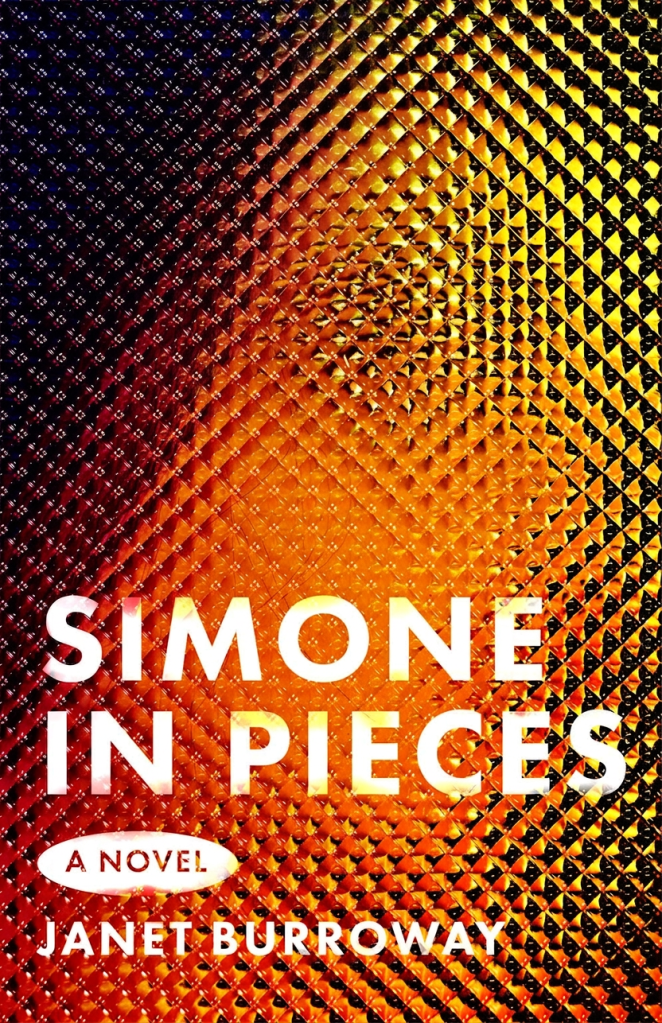
This evocative, formally elegant novel introduces Simone Lerrante, a Belgian war orphan, as a child refugee in Sussex, England, her memory damaged by trauma. The publisher, the University of Wisconsin Press, notes that the novel “offers a kaleidoscopic vision of Simone’s fractured life and piecemeal understanding of self across multiple points of view. Following her from Cambridge to New York City and across the United States, through a disastrous marriage, thwarted desire, and the purgatory of academic backwaters, the novel charts Simone’s unexpected reconnection with her past, which provides both autonomy and inspiration for her future.”
Our group agreed with the overwhelming critical response praising this formally impressive novel’s “brilliant structure” and emotional heft. The novel uses a kalidoscope structure to “piece” together the life story of Simone Lerrante, a Belgian war orphan, from her childhood entry into England as a refugee at age 10, through her complex and rich life as an eventual scholar of literature. The novel uses multiple perspectives across a linear time line to trace her journey from Sussex to Cambridge, to NYC and across the US. Between each major shift in location, the novel includes that it calls “transits” that are short depictions of her movements.
Different characters give us access to different “pieces” of Simone’s life, in a mosaic structure that mimics the novel’s concerns with memory and selfhood.
Like so many of the novels we read this season, this is a novel about memory and about consciousness, about our sense of ourselves, created through fragments, or pieces and prismatic points of view
As in The Correspondent, we learn about people from the views of othersm but here Burroway uses a more complex formal structure than the epistolary: rather than a life through letters, the “telling” of Simone’s experience is interspersed with other people’s points of view and details of their lives that she never knows.
The novel’s pleasure in form and literary structure is also demonstrated in its many literary allusions and Burroway’s self-aware use of language as a trope. In this narrative, words are both a plot device (puzzles, word play, literary study, translation) but the novel also is concerned with how words can shape or fail to shape meaning.
Chapters draw on famous texts such as T.S. Eliot’s “Prufrock” and Sylvia Plath’s Letters Home and the novel iis filled with both literary and cultural allusions and spirited literary theoretical discussions (that Burroway, like her character, is an academic, informs her witty, and erudite, content, and the pleasure of “spotting” an allusion it is enjoyable, but we appreciated that the novel does not require that one recognize these allusions in order to enjoy or understand it.
We found the novel’s real strength is its emotional core.
For example, the following quote resonated powerfully with our group, all members of the Oakland Senior Center:
I am sure it is always a disappointment to be old, But it is a shock to feel so unfinished, so in process, so an experiment still in the works. I am not done yet, I have not been exercised. I have not drawn breath to the bottom of my lung’s capacity, i have not run to the end of the oak-canopied path, I have not seen enough species of parrot in their histrionic coloration,. I have not been sufficiently mothered, fathered, friended, loved. I am still on the verge, dissatisfied, still yearning, I am not ready to be relegated to a resource
This quote hit home for all us. Here, Borroway shows, as she does often in this excellent novel, what exceptional writing can do: articulate our common experience in ways that feel as though someone got in our heads.

