Our original discussion date for The Vulnerables was lost when the Senior Center’s internet went down, so we combined it with our scheduled discussion of Evensong. The pairing turned out to be a happy accident: two slim novels, both about vulnerability, both about aging, and both about the small acts of care that hold people together.
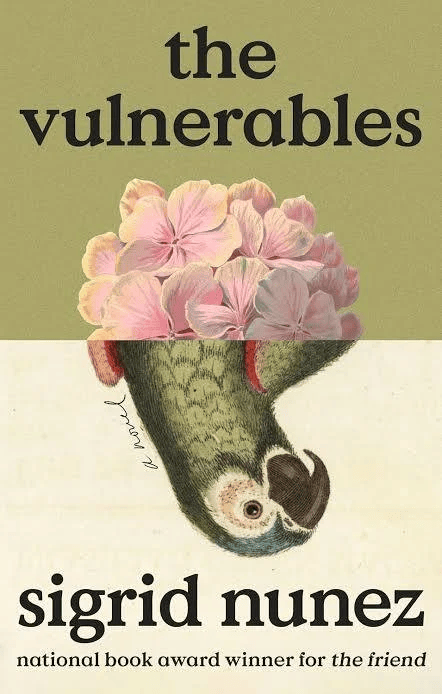
Sigrid Nunez’s The Vulnerables (Riverhead Books, November 7, 2023) is set in New York City during the first months of the COVID-19 lockdown. Its narrator, an unnamed writer, gives up her own apartment to a doctor who has come to help with the crisis and moves into a wealthy acquaintance’s spacious apartment to care for a macaw named Eureka, whose owners are stranded in California. She is soon joined, unexpectedly, by a troubled college student. Like Nunez’s The Friend (2018) and What Are You Going Through (2020), the book is less a conventional plot than a meditation on aging, illness, writing, animals, and what it means to be vulnerable.
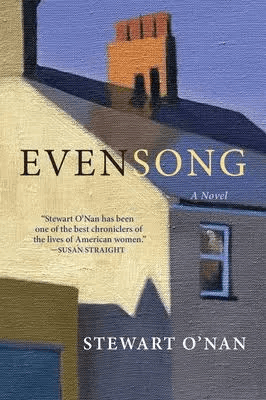
Stewart O’Nan’s Evensong (Atlantic Monthly Press, November 11, 2025) follows four elderly women in Pittsburgh’s East End — Emily Maxwell, her sister-in-law Arlene, and their friends Kitzi and Susie — who are the core members of the Humpty Dumpty Club, a loose network of church-choir women who look after one another and their aging neighbors. When their leader, Joan, is sidelined by a bad fall, the others must take up the work. The novel runs from September 2022 to January 2023 and is the third book to feature Emily, after Wish You Were Here (2002) and Emily, Alone (2011).
The Vulnerables
Several of us had read The Vulnerables over the summer with mixed reactions. We were not sorry to have read it, but none of us felt compelled to recommend it to anyone else.
On a second reading closer to our discussion, however, each of us was surprised to find that our response had changed. We came away with a sense that Nunez had captured our collective cultural vulnerability — a vulnerability rooted in COVID and the pandemic, but also in climate change and in a harsh political and economic environment.
We were less bothered, the second time around, by the seemingly petty concerns of the novel’s wealthy and entitled characters, who could flee the city for their vacation homes and hire out the care of an expensive exotic bird that has an entire gilded room of its own, with hand-painted walls. The world of the novel feels somehow flat, devoid of hope — and yet we saw in it an eerie reflection of our own lives, in which everyone feels vulnerable.
Evensong
In Evensong, Emily Maxwell of Emily, Alone has grown some fifteen years older and is one of several women who make up the Humpty Dumpty Club — a group who have grown old together, sung in the church choir, participated in local activities, and grown interdependent. Most have outlived their husbands; some are divorced; and all rely on one another. They organize their tasks and keep careful records: hospital visits, errands to the pharmacy, transportation to medical appointments, all within their Pittsburgh neighborhood.
We enjoyed the strong sense of a specific place, right down to the street names. But unlike the characters of Evensong, we live in a more diverse area, and most of us did not grow up in the kind of community the book describes. The world of the novel felt somewhat provincial and old-fashioned to us — even though the losses that go with aging are very much part of our own daily lives as well.
We all agreed that we appreciated having read this book and would gladly recommend it to others. We speculated a bit about how a male novelist could be so acutely aware of the details of the lives of elderly women.
So far in this Fall session, Umrigar and Strout are about what families withhold, while Nunez and O’Nan are about exposure, to a virus, to loneliness, to aging, and what people do for each other once it can’t be hidden. Artie’s worn-down political despair in Strout echoes the flat, anxious world of The Vulnerables.
We love the way the Humpty Dumpty Club shows us where and how a community actually shows up. And I want to end today’s blog with how crucially important that we, as a book group, as readers, show up for one another, for our conversations about life, for our shared belief that reading and conversation are not ancillary but central, and for the simple and essential practice of being present with one another every two weeks.

