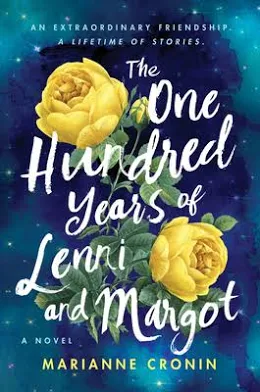
Marianne Cronin’s The One Hundred Years of Lenni and Margot (Harper Perennial, June 1, 2021) is set in the Glasgow Princess Royal Hospital, where seventeen-year-old Lenni Pettersson meets eighty-three-year-old Margot Macrae. Realizing that together they have lived one hundred years, the two become friends and begin telling each other the stories of their lives. The novel is at once a story of intergenerational friendship, a meditation on faith and dying, and a celebration of love in its many forms.
(Spoiler’s alerts ahead)
We all enjoyed The One Hundred Years of Lenni and Margot, though several of us had trouble getting into the novel, while others found it compelling from the beginning. Some of us loved 17 year old Lenni; others found her annoying. We all agreed that the book is well written and that, although both Margot and Lenni are dying, it is filled with good humor and wit, and a fierce sense of the value of connections and being present.
We had differing reactions to the passages in which Lenni questions Father Arthur about truth and religion, and wondered aloud how our individual life experiences, rather than the writing, might determine our responses to these moments. For example,
Lenni refers to his robes as dresses and assumes that the opening of the Lord’s Prayer, “Our Father, who art in heaven,” means that God is doing art in heaven, and that this is why we should make art. Some people find this charming and others found her ignorance or questions preposterous.
We noted that Father Arthur and the chapel provide Lenni a safe and kind space that allows her to escape the often boring and restrictive May Ward for children with incurable diseases. We are never told what she is dying of or see her getting treatments; we simply know she has been left in the hospital by her father whom she tells not to return until she is “actively” dying because his sadness is too depressing.
We enjoyed Margot’s stories, and we found it sensible that, at eighty-three, she had more of them than seventeen-year-old Lenni. For example , Margo had a child who died in infancy; her husband left soon after and when she tried to track him down, she ends up in a London police station where she meets the madcap and rebellious Meena who is in trouble for animal activism. Meena offers Margot an escape, freedom from her failed marriage and dead child and pulls her into a life of adventure. Years later, Margot marries Humphrey, a quirky astronomer, after almost running him over while he is star gazing. Meena and Humphrey both loved Margot and in different ways each freed her from the normative restrictions of her era’s gender and class expectations.
Humphrey ends up with dementia living in an institution, and we were moved by the scenes when he pretends not to know Margot and urges her to go and find the person she loves, whoever he or she is. He had made her sign a contract that once he no longer recognized her, she would stop coming to visit. We realize that is aware of Meena and that he has pretended not to recognize Margot so that she can get on with her life, and she does.
We wondered how such a young author (she wrote this novel in her twenties) could write so convincingly about old age. We all agree that the novel would also make a terrific movie. While this novel is about death, we found it a wonderful celebration of our capacity for connection at any age, and ee ended our discussion determined to read Cronin’s second novel, Eddie Winston Is Looking for Love.

